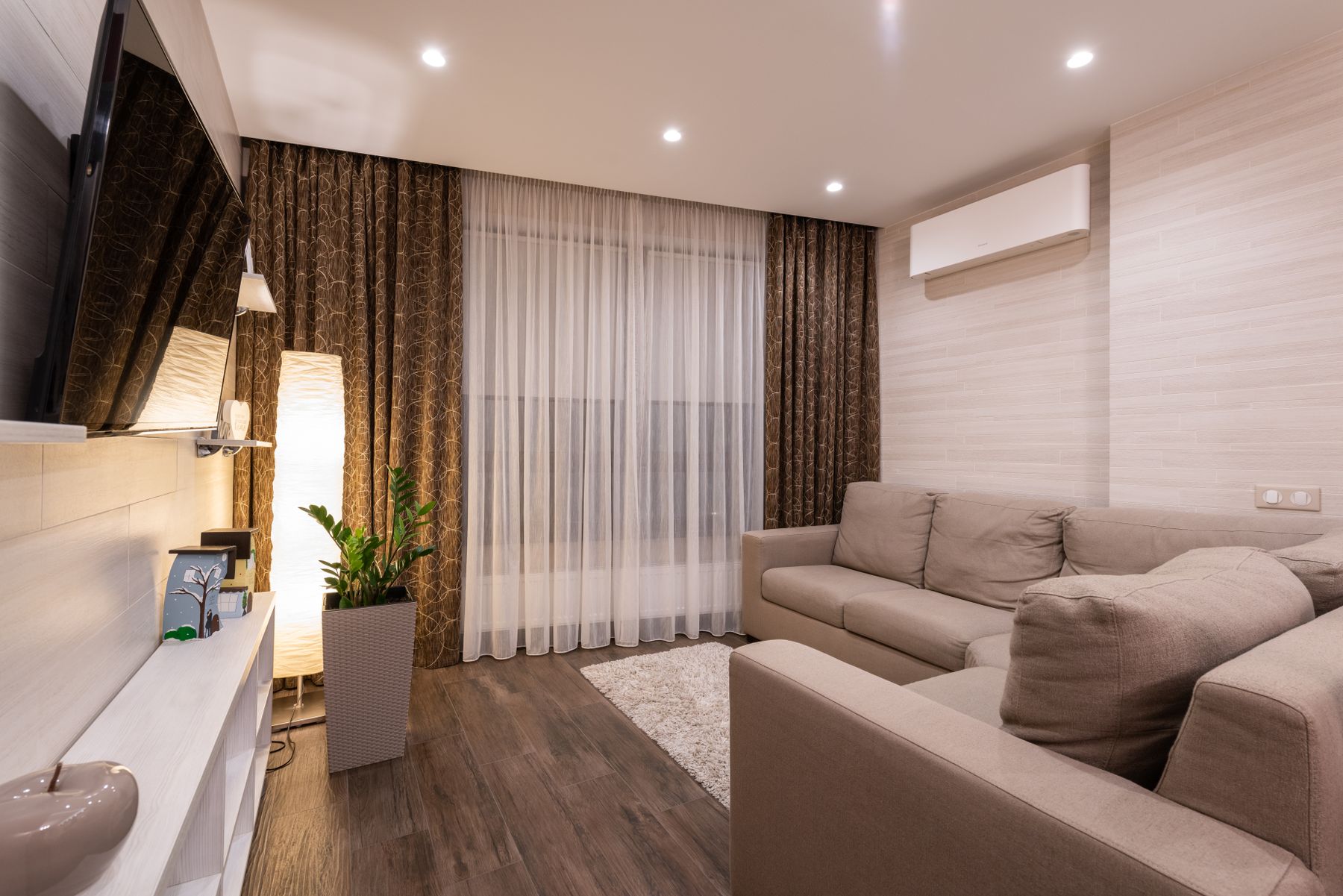
Window treatments are the most underestimated line in a renovation budget. They are the difference between a room that feels finished and a room that feels rented, between a bedroom that actually sleeps and one that wakes you at sunrise, and between a drafty old house and a comfortable one. We have seen $400 of the right curtains do more for a room than $4,000 of the wrong sofa.
This guide compares the four real categories — curtains, blinds, shades, and shutters — by what each one does well and where each one falls short. It also covers how to measure them correctly, how to layer them, and which treatment fits each room by function.
The Four Categories, Briefly
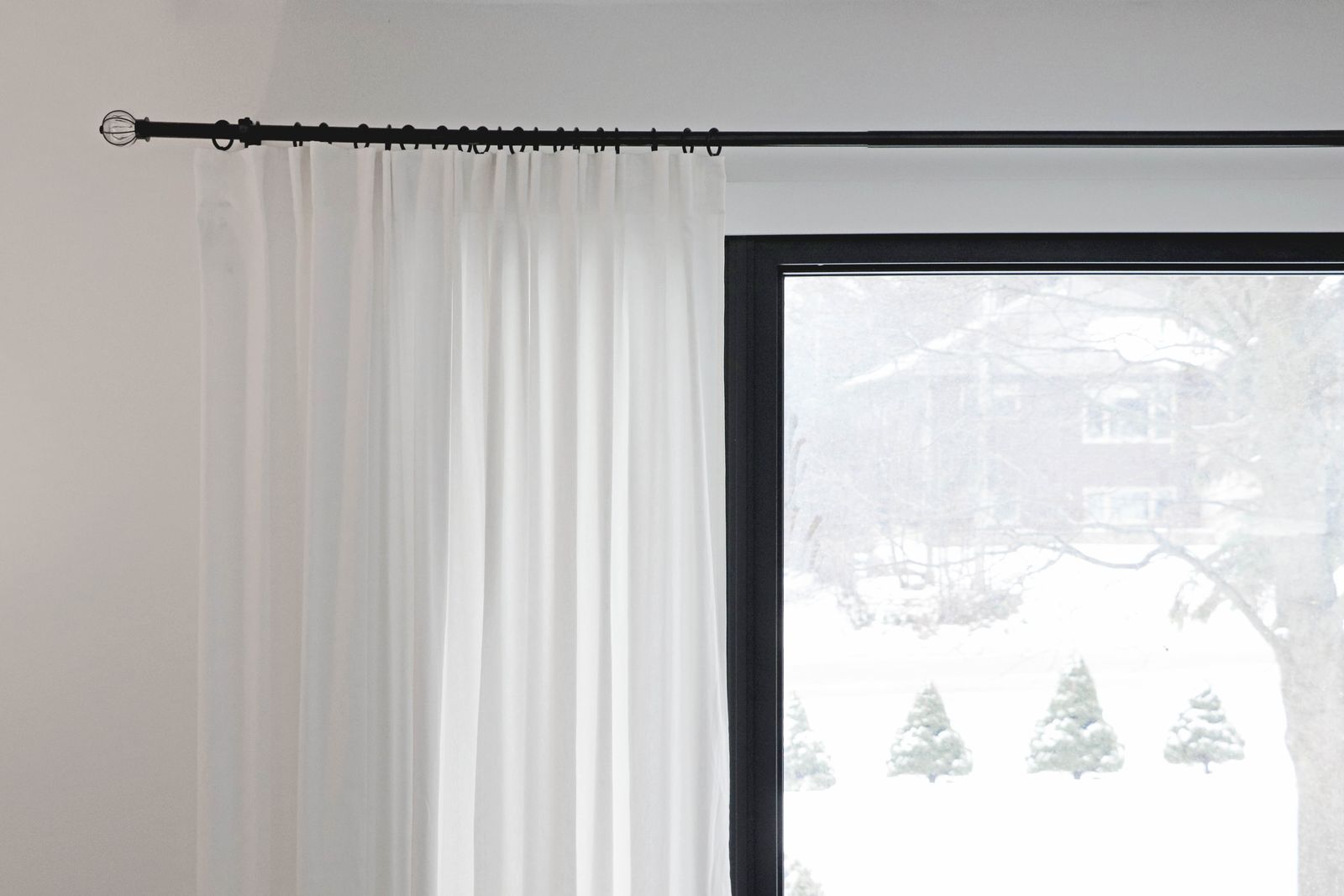
Curtains and drapes are fabric panels hung from a rod. They handle softness, sound absorption, and insulation well. They are weak at precise light control unless you line them with blackout fabric or layer them.
Blinds are hard slats — wood, faux wood, or aluminum — that tilt to control light. They give the most precise light and privacy control of any category. They are not great at insulation on their own and they have a corporate-office look unless you commit to a real material.
Shades are continuous rolls of fabric — roller, roman, cellular, woven — that raise and lower. They are the cleanest visually, the best at insulation (in the cellular form), and the easiest to motorize.
Shutters are hinged panels with fixed louvers, usually mounted inside the window frame. They are the most permanent, the most expensive, and the most durable. They raise property value in some markets and lower flexibility in others.
Each does one job well. No single category wins all jobs.
Curtains and Drapes: What They Actually Do
Curtains are mostly about the room they live in. They soften a wall, absorb sound, layer over hard windows, and insulate the worst-performing windows in older homes. A heavy lined curtain can reduce heat loss by 25 percent on a single-pane window, which is meaningful.
What curtains are bad at is precise light control. Sheer curtains admit most of the light and block a little. Light-filtering curtains admit a softer wash. Blackout curtains block almost all light, but they need to be properly mounted — gap at the rod or the floor equals light leak around the edges.
The most common curtain mistake is hanging them too small and too short. A curtain rod should extend 8 to 12 inches past the window frame on each side and 4 to 6 inches above the frame, often closer to the ceiling. The panels should be 1.5x to 3x the width of the window for proper fullness, and they should kiss the floor or break 1 to 2 inches above it.
For real numbers: a 48-inch window with a 96-inch ceiling deserves a 60- to 84-inch-wide rod and panels that measure 96 inches long. The West Elm Belgian Linen Curtain ($159 to $229 per panel) hangs beautifully in this configuration. The IKEA AINA ($30 per panel) and the Quince Linen Curtain ($69 per panel) are both honest mid-range picks. The Restoration Hardware Belgian Linen Drape ($400 to $600 per panel) is the reference for what a properly made lined linen drape looks like — heavier, better light-blocking, and noticeably better falls.
Lining is where most curtain budgets should go. An unlined curtain at $150 looks worse than a $100 lined curtain. A $40 blackout liner from Amazon paired with a $70 curtain panel beats a $150 unlined panel every time.
Blinds: When Precision Matters
Blinds are the right call when you need to tilt light without raising the window covering. Kitchens with morning sun, home offices with screens, and bath windows all benefit.
Real wood blinds at 2-inch slats — Hunter Douglas, Levolor, Graber — run $200 to $500 per window. Faux wood blinds look 80 percent as good, last better in humid bathrooms, and run $80 to $200 per window. Aluminum mini-blinds at Home Depot ($25 to $50 each) are dated and frankly belong in a rental.
The most common blind mistake is buying them inside-mount on a window that is not perfectly square. Inside-mount blinds show every gap and twist. If the window is not square, outside-mount the blinds and accept a slightly different look.
For precise light control, blinds are unmatched. For full blackout, they are not the answer — even closed, light bleeds through the slats and the cord holes.
Shades: The Quiet Workhorse
Shades are the most flexible category. Roller shades (a flat panel that rolls up) are minimalist and modern. Roman shades (fabric that folds up in horizontal panels) are softer and more traditional. Cellular shades (honeycomb-shaped fabric cells) are the best insulator on the market, with a 3.5-inch cellular construction adding R-4 to R-8 to a single-pane window. Woven wood shades (bamboo, jute, matchstick) sit in the natural-materials niche and look right at home in coastal, southwestern, and minimalist interiors.
Pricing depends on the type and material. Basic roller shades run $50 to $150 per window at companies like IKEA, Blinds.com, and Home Depot. Cellular shades run $150 to $400 per window for cord-operated, $250 to $700 per window for motorized. Roman shades in a quality fabric run $300 to $600 per window. Woven woods run $200 to $500 per window for a non-motorized, $400 to $900 motor-operated.
The breakout decision points:
- Roller: Choose for cleanest visual. Best for rental-friendly installs because they look like a screen.
- Roman: Choose for traditional or transitional interiors. They soften a wall.
- Cellular: Choose for any room where insulation, blackout, or noise reduction matters. Bedrooms, nurseries, and home offices benefit most.
- Woven wood: Choose for honest natural materials. They admit dappled light beautifully.
The mistake to avoid with shades is motorized everything. Motors add $200 to $400 per window and are only worth it for windows that are hard to reach — tall windows, behind furniture, and skylights. Otherwise, cord-operated is fine.
Shutters: The Forever Choice
Shutters are permanent. They mount inside the window frame, hinge open like a door, and last 15 to 25 years. Real wood plantation shutters in 3.5- to 4.5-inch louvers run $400 to $800 per window installed. Composite shutters from brands like Polywood or Norman start at $250 to $500 per window installed. The cost is real, but the ROI in resale in markets like the Southeast, Texas, and Florida is meaningful.
Shutters do three things well: precise light and privacy control, durability, and clean visual integration. They are also the only category that does not move out of style — plantation shutters are as current in 1975, 2005, and the present day.
They are bad at insulating. They are bad at blocking sound. They are bad at softening a room with fabric. And they are bad at being changed — once installed, replacing them means new hinges and frame work, not just unhooking a rod.
For a primary suite where you intend to live ten years, shutters on the bedroom windows are a fine call. For a rental, never — they will not transfer with the lease.
How to Measure Correctly
The measurement errors drive most returns. Here is the discipline we use:
Inside mount
- Measure the width at three points — top, middle, bottom — and use the smallest.
- Measure the height at two points — left, right — and use the largest.
- Subtract 1/4 inch from each side for clearance.
Outside mount
- Measure the desired width and height of the area to be covered.
- Add at least 4 inches on each side for light blocking.
- Add at least 4 inches above for visual height.
Length
- Sill length: panel ends 1/2 inch above the sill.
- Apron length: panel ends 1/2 inch above the apron (the trim below the sill).
- Floor length: panel kisses the floor or breaks 1 to 2 inches above.
- Puddle length: panel puddles 2 to 6 inches on the floor (formal look, not great for families with pets).
A simple rule for length: 96-inch panels cover most 8-foot ceilings. 108-inch panels cover 9-foot ceilings. Anything above 108 inches needs to be hemmed or ordered through a curtain workroom.
Layering: The Real Upgrade
Layering a window treatment is what transforms a room. The standard moves:
Curtain over blind: A wood or faux-wood blind underneath gives you daily privacy control, with a curtain layered over for softness and full blackout when needed. This is the most common primary suite combination.
Curtain over roller shade: A blackout roller shade hides behind a curtain panel. You get precise light control from the shade and the layered softness of the curtain over it. This is the most common bedroom combination in contemporary homes.
Double rod with sheer and main panel: Two panels on a double rod — sheer first, opaque behind — gives you daytime filtering and nighttime privacy in one motion.
Roman shade over woven wood: Uncommon but effective. A flat roman shade on top of a woven wood gives you the texture of the natural material and the precise light control of the shade.
Layering adds cost — typically $200 to $400 per window in additional materials and labor. We think it is worth it in primary suites, dining rooms, and any room where you sit for long periods.
Room-by-Room Picks
Living room: Curtain over roller, or a single curtain with a quality lining. The room is for gathering, not sleeping, so light control is less critical. A sheer layered behind a main panel is a strong move.
Primary bedroom: Blackout shade behind a curtain panel. The combination handles the sunrise wake-up issue that no single category solves alone. Cellular shades work especially well here.
Nursery or child's room: Cordless cellular shade, top down bottom up. The cordless is non-negotiable for child safety. Top down bottom up gives privacy at the lower half with light at the top — helpful for nap-time light management.
Bathroom: Faux wood blind or top-down bottom-up cellular shade. Real wood warps in humidity. Privacy at the bottom, light at the top is the goal.
Kitchen: Roller shade, often in a wipeable vinyl or polyester. Easy to clean, lets in sun during prep, blocks sun when the chef is cooking.
Home office: Solar roller or zebra shade for screen glare control without losing view. Top-down bottom-up also works.
Hallway and staircase: Woven wood or cellular shade, low maintenance, no curtain to catch on foot traffic.
The bottom line
Pick the category by the job, not by the look. Curtains soften, shades insulate, blinds and shutters control light precisely, and layering two treatments handles most rooms better than one. Measure three times — especially length — and order 15 percent extra fabric for curtain projects so a return for an off-cut is not in your future.