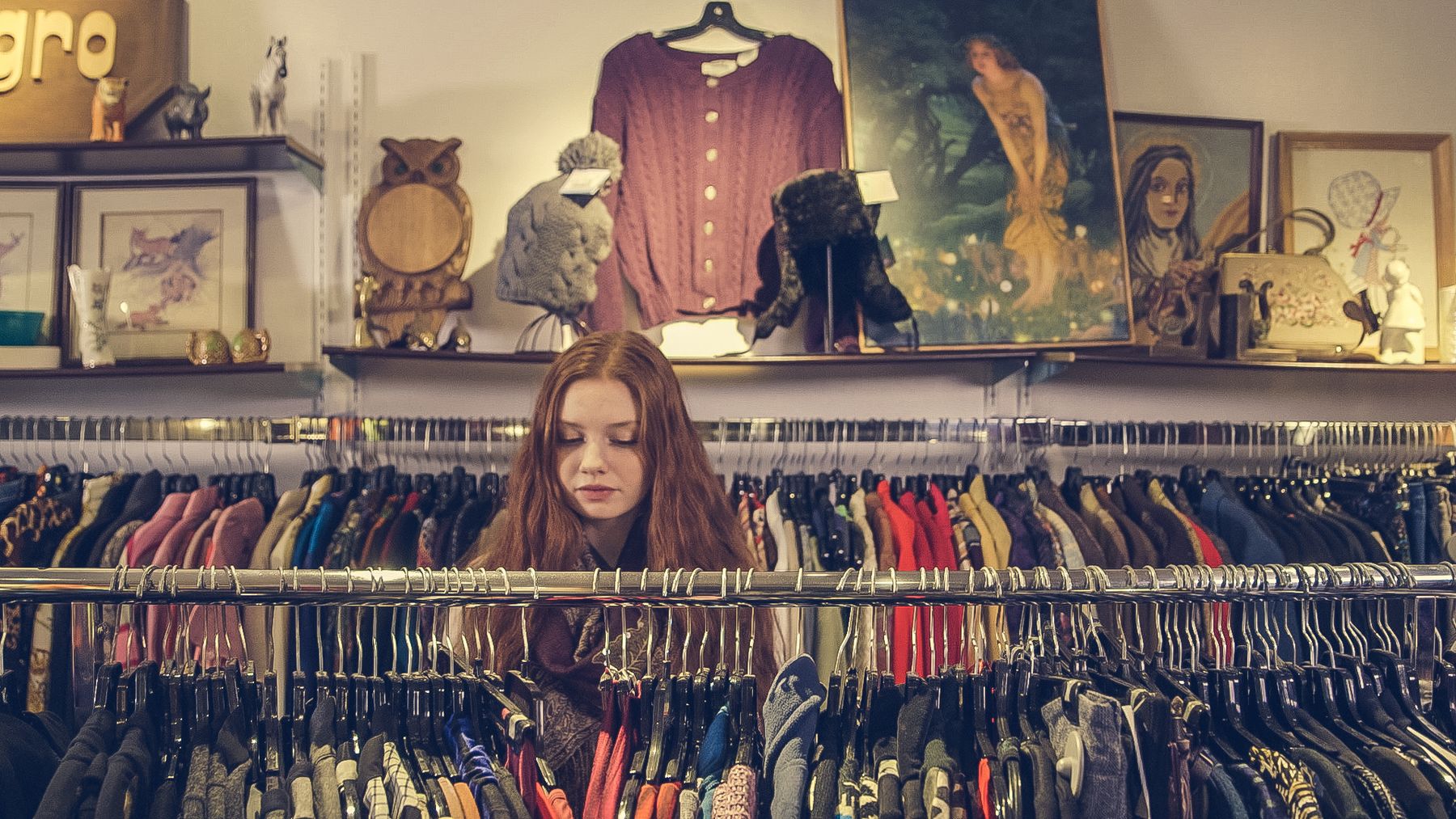
Vintage isn't a style — it's a budget strategy, a sustainability choice, and a wardrobe upgrade. A $45 vintage Levi's trucker replaces a $148 new Madewell jacket. A $245 vintage Ralph Lauren blazer replaces a $600 new one. The catch is knowing what to look for, what to skip, and how to read an era tag. Here's how we approach shopping vintage without spending an entire afternoon elbow-deep in a thrift store bin.
The four eras worth knowing
The vintage trade runs on a calendar. Different decades of clothing have predictable fabric quality, silhouettes, and prices. Knowing the era you're shopping makes you five times faster.
60s mod. Mary Quant, André Courrèges, Pierre Cardin. Geometric shifts, mini lengths, A-line coats, contrast trim. Look for: high-quality wool crepe, lined everything, real leather buttons, hand-finished hems. Reasonable price range: $95–$295 for a dress, $145–$245 for a coat. Best labels: Mod originals (vintage boutiques), Mr. Freedom, Betsey Johnson early work.
70s boho and disco. Halston, Ossie Clark, Yves Saint Laurent. Caftans, jumpsuits, halters, peasant blouses, wrap dresses. Look for: silk and rayon instead of polyester, geometric or floral prints, chunky wooden beads. Price range: $75–$325 for a dress, $185–$485 for a Halston or YSL piece. Hardest era to fake — real 70s pieces have distinctive dye.
80s power dressing. Azzedine Alaïa, Thierry Mugler, Claude Montana, classic Ralph Lauren and Donna Karan. Shoulder pads, structured blazers, bias-cut gowns, monogram scarves. Look for: visible construction (interfacing, pad-stitching), heavier fabrics, lined tailoring. Price range: $148–$445 for a blazer, $245–$895 for a Mugler or Alaïa.
90s minimal. Helmut Lang, Jil Sander, Calvin Klein, early Marc Jacobs. Slip dresses, clean trousers, leather, minimal hardware. Look for: viscose and modal, low-contrast stitching, no logos, hidden zippers. Price range: $145–$395 for a slip dress, $245–$545 for a vintage Helmut Lang piece.
Each era has a "fake" — period-inspired pieces made later with modern construction. A 2018 Free People dress isn't 70s, even if it looks like one. The vintage trade distinguishes "vintage" (at least 20 years old) from "vintage-inspired" (reproduction). Both are valid; they just price differently.
Where to shop: platforms ranked by what we found
Vintage has gone online. The platforms have predictable strengths and predictable ghosts.
Etsy. Best for curated pieces and small-batch vintage sellers. Vintage Levi's, vintage Ralph Lauren, and silk scarves arrive at consistent quality from sellers with reviews. Search by label, not style: "Ralph Lauren vintage blazer" beats "80s blazer" in result quality. Price range: $45–$295 for most pieces.
Depop. Best for 90s and 2000s pieces, streetwear, and Y2K revival. Younger sellers, faster turnover, more trend-driven. Strong on denim, vintage band tees, leather jackets. Filter by era — Depop's UI exposes this clearly. Price range: $25–$245 for most pieces.
Poshmark and Mercari. Best for mainstream brands at thrift-store pricing — Ann Taylor, J.Crew, Madewell pieces that are 5–15 years old. Less curated, slower shipping, more negotiation. Sort by "newly listed" and check daily.
eBay. Best for hard-to-find labels and luxury vintage. The auction format pushes prices up on popular pieces, but the "buy it now" inventory from established sellers is reliable. Filter by completed listings to see actual sell-through prices before bidding.
Specialty platforms. Beyond Retro (London-based, US shipping) for the cleanest 80s and 90s curation. Rag & Bone's vintage line via their site for designer denim. The RealReal for authenticated luxury vintage at 40–70% off original retail. Vestiaire Collective for hard-to-find designer pieces with authentication guarantees.
Real-life thrift. Salvation Army, Goodwill, and local church thrift stores carry the widest range but require patience and an afternoon. Best days to shop are Mondays (after weekend drop-offs) and during specific bag-sale events. Bring a tape measure and skip the top racks — they're picked through. Go to the bottom of the bin.
The brand picks by category
For denim, three names carry the strongest vintage market:
Levi's Vintage. Levi's reissue line ($98–$245) uses original patterns, fabrics, and details from specific decades. The 1954 501z ($145), the 1966 505 ($115), and the 1978 518 corduroy ($145) are standouts. Buying reissue is cheaper than authentic vintage and almost identical.
Re/Done. Founded on reconstructed vintage Levi's. The "High Rise Ankle" and '70s flare styles ($185–$295) come from vintage 501s re-seamed with a modern fit. The reissue is more sustainable than new denim and more flattering than raw vintage.
Frame. Known for clean, '70s-inspired fits. The "Le Cut" and "Le Original" styles ($218–$258) at Saks, Net-a-Porter, and Nordstrom. Their "Vintage Re-Issue" line brings back specific washes.
For outerwear, the strongest vintage plays are:
Levi's Type III trucker jacket (any era, $65–$245 vintage). Burberry's classic trench (1970s and earlier, $295–$895). Ralph Lauren Polo Bear sweaters (1991–1992 specifically, $295–$895). Schott Perfecto leather jackets (1970s and earlier, $485–$1,295).
For everyday wear:
COS. A modern label with vintage-inspired cuts. The wide-leg wool trouser ($175) and chunky cardigan ($135) reflect a 70s sensibility without literal vintage pricing.
Aritzia Wilfred. Reflects 90s minimalism in current cuts. The "Bowen" slip dress ($148) and contour dress ($168) lean Helmut Lang without the premium.
Reformation. Industrial-vintage pattern-making has reduced the carbon footprint of a slip dress, but the silhouette reads vintage. The "Liat" mini ($188) and "Brigitte" midi ($295) hit the era without paying for it.
J.Crew. Mid-2000s J.Crew pieces (2003–2010 specifically) have become collectible vintage. Look for the broken-in cashmere and the structured chino with original tags. The current "rollneck" line draws from this era.
Signs of a quality piece (and signs to walk away)
Vintage quality varies wildly. These checks take thirty seconds and save hundreds.
Stitching. Look at the inside seams. Hand-finished hems with tiny, even stitches indicate a quality piece. Long machine stitches with loose thread ends suggest a modern reproduction or fast fashion.
Zippers. "YKK" and "RiRi" are modern. Talon, Scovill, and "L" original zippers are vintage. A stuck-but-smooth zipper is acceptable. A sticky or corroded zipper means it's near end of life.
Buttons. Plastic buttons mean low-quality or modern. Shell, horn, mother-of-pearl, or wooden buttons indicate quality. Buttons with shanks (not holes) are an era marker for 60s and earlier.
Lining. Viscose, Bemberg cupro, and silk linings are quality. Acetate and polyester linings are mid-tier. No lining at all is intentional (a slip dress) or a red flag.
Labels. Original labels from the era are gold. A 60s Mr. Freedom piece with its original label is worth 3–5x the same piece unlabeled. Look at the label carefully — if a 2020 piece claims to be from the 60s, the label font, the company's location, and the stitching around the label will look modern.
Smell. A mildewy or chemical smell is a hard pass. Mothball smell means it was stored somewhere with poor ventilation, which often signals hidden damage.
Stains. Inspect every piece under good light. Oxidation on white silk is permanent. Yellowing at the armpits on shirts means they weren't washed before donation. Set-in stains on knits are nearly impossible to remove.
Pilling. Surface pilling on sweaters is acceptable; deep pilling that has felted the fabric means the piece is at end of life.
A piece that passes these checks is a keeper, even at top-of-range price.

How to build a vintage capsule without looking dated
The trick to vintage is using older pieces as accents, not the whole outfit. A vintage silk scarf against a COS slip dress reads intentional. A vintage silk scarf, vintage jeans, and a vintage sweater reads costume.
Three vintage capsules that work:
Capsule one: 90s minimal. Vintage Helmut Lang slip dress + COS cashmere cardigan + Aritzia leather ankle boots + The Row bag (current).
Capsule two: 70s boho. Vintage caftan (cotton, not polyester) + Frame '70s flares + Vagabond platform sandals + vintage leather crossbody.
Capsule three: 80s power. Vintage Ralph Lauren blazer (men's, tailored down) + COS straight-leg trouser + Re/Done '70s jeans (rotating) + Schutz heeled ankle boot.
In each case, the vintage is one to two pieces in a five-piece outfit. The rest is current, well-fitting, and refined. The overall look reads as someone with taste, not someone in a period film.
Negotiating price and reading the market
Vintage pricing is negotiable in person and on Poshmark and Mercari. Online platforms have offers and bundle discounts.
Use eBay's "sold listings" filter to see actual transaction prices, not asking prices. A vintage Levi's trucker listed at $185 often sells for $85–$135. A real Halston caftan listed at $450 holds closer to $400.
Bundle discounts of 10–20% work at thrift stores on slow days. Beyond Retro and other curated vintage shops offer rotating sales every 6–8 weeks. Etsy and Depop shops offer first-time-buyer discounts visible in their banners.
Buy your size, your fit, and your color even at a discount. A vintage piece at 50% off that doesn't fit is still wasted money.
The bottom line
Shop the era, not the trends — 90s minimal, 80s power, 70s boho, and 60s mod dominate the resale market for a reason. Inspect the stitching, zippers, and labels, and skip anything that smells off or has set-in stains. Two vintage pieces per outfit, three at most, reads as taste; five reads as costume.