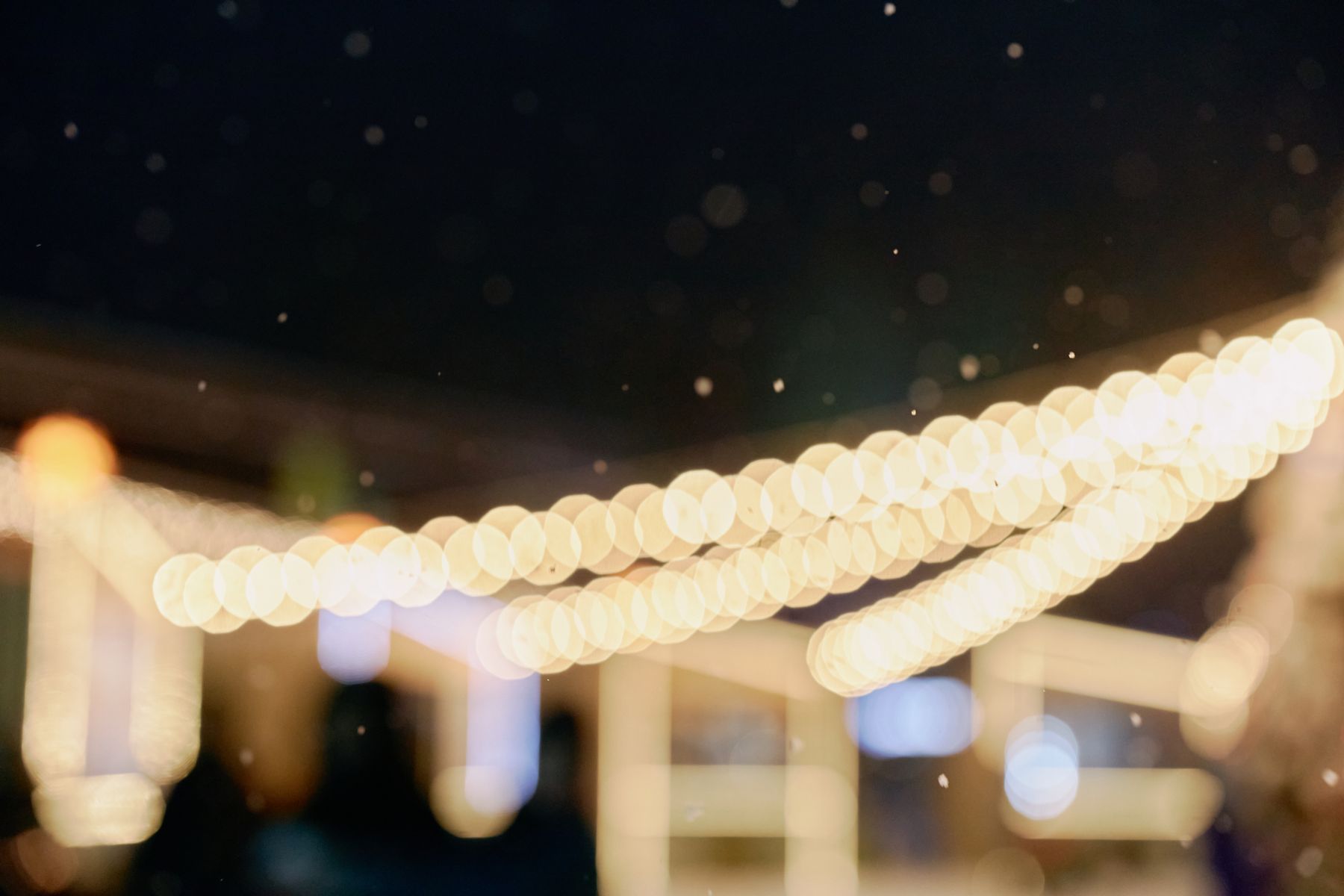
A patio with a single string of bulbs looks like a party. A patio with layered lighting looks like a room. The difference is not money — it is the plan. When we design a backyard for evening use, we think in three layers: ambient (the overall glow), task (light where you cook or eat), and accent (the highlights that make the architecture sing). Each layer answers a question. Ambient answers "can I see my guests?" Task answers "can I read the menu?" Accent answers "does this place feel intentional?"
The three layers and what they do
Ambient light is the base layer. It is the soft, indirect glow that fills the space and lets people navigate without bumping into furniture. String lights, paper lanterns, and overhead fixtures on dimmers are ambient. The output you want here is low, around 20 to 50 lumens per square foot of seating area, which keeps faces lit without glare.
Task light sits where specific activities happen. The brightest light in your backyard belongs over the grill and the dining table. A pendant over an outdoor dining table should hit 100 to 150 lumens per square foot at the table surface — enough to read a menu without straining. Path lighting at 30 to 50 lumens per fixture counts as task because its job is safe navigation, not atmosphere.
Accent light is the highlight layer. Uplighting on a tree trunk, a spot grazing a stone wall, a wash of light on a textured facade — these are the things that make the architecture look like itself at night. Accent lighting runs hot and targeted. A 200-lumen spotlight 4 feet from a wall reads as a gentle wash; the same fixture 12 feet away is too bright and too small in coverage.
When all three layers work together, you can dim ambient for a dinner, crank task for a board game, and let accent do the quiet work in the background. The mistake most homeowners make is buying one string of lights and expecting them to do all three jobs.
String lights: the workhorse of ambient
String lights are the most forgiving lighting choice for a first project. They are cheap, easy to install, and the result is immediately photographic.
Bulb types matter. Incandescent G40 or G50 bulbs (the round, dimmable ones) put out around 30 to 50 lumens each and last 1,500 to 3,000 hours. LED filament bulbs hit the same look at 5 to 7 watts and last 15,000 hours. For a 25-foot run, expect 15 to 20 bulbs and roughly $90 to $180 for the strand plus bulbs.
Plan the support. String lights need two anchor points at least 8 to 10 feet apart, and they sag between anchors. You have three practical options:
- Pergola or existing structure. Run lights along the beams or attach hooks to the wood. The simplest install.
- Poles in planters. Two 4×4 cedar posts set in 12-inch planters filled with concrete (a $40 project per pole) carry a single strand without much sag.
- Wall anchors. Eye bolts into brick or wood at each end of a courtyard, then tension the strand with a turnbuckle.
For the bulbs themselves, we like the Feit Electric 25-foot LED string (Home Depot, $90 for the strand plus bulbs) and the Brightech Ambience Pro solar-compatible LED string ($75, available on Amazon) for locations without an outlet. Commercial-grade options like the Patio Lights 48-foot LED strand ($160 at 1000Bulbs.com) use heavier 14-gauge wire that survives wind better and supports longer runs.
Path lights: task lighting that earns its keep
Path lighting is the most contested category. Done well, it is invisible and effective. Done badly, it looks like a runway. The rule we follow: use warm white (2700K to 3000K), low-output fixtures spaced 6 to 8 feet apart along the path edge, and aim them down and slightly outward.
The mid-range pick is the Hampton Bay Low Voltage 4-Tier Path Light ($18 each at Home Depot), a die-cast aluminum fixture with a 12-watt LED bulb rated for 15,000 hours. Higher-end choices like the FX Luminaire PB (Professional Brass) path light run $90 to $130 per fixture but look like they belong in a public garden. Kichler has a wide mid-range line as well — the Kichler 15810 LED path light ($35) is a popular step-up from the Hampton Bay.
For a 50-foot path, expect 6 to 8 fixtures plus a transformer and wire. A 100-watt low-voltage transformer from Malibu or Hampton Bay runs $50 to $80. The wire (12-gauge, direct burial) is $0.50 to $1.00 per linear foot. So the installed cost is roughly $250 to $400 for a real path lighting system.
Uplighting and downlighting: the accent layer
Uplighting places a fixture at ground level aimed up at a tree trunk, a stone wall, or a sculpture. It dramatizes texture. The classic approach uses a 200 to 400 lumen LED spotlight with a 20-degree to 35-degree beam, mounted 1 to 3 feet from the subject.
For trees, the FX Luminaire RB (Recessed Box) uplight ($110 to $160) is the contractor favorite. The cast-brass body sits flush with the soil or mulch and disappears in the daytime. The Kichler 15394 ($90) is a spot-style fixture that mounts on a stake and is easier to install yourself.
Downlighting mounts fixtures high (under a soffit, on a tree branch, or on a tall pole) and aims them down. Tree-mounted downlighting is the technique the high-end resorts use to make a parking lot look like a forest. The fixture is a 12V MR16 LED spotlight inside a weatherproof housing, clipped to a branch 8 to 15 feet up. The light passes through the canopy and lands in soft dappled patterns below.
If you have a tall evergreen, even a single downlight on a 15-foot branch transforms the way the tree reads at night.
Solar versus low-voltage: the honest comparison
Solar lighting has come a long way, but the tradeoffs are real.
Solar pros: No wire, no transformer, no electrician. Move the fixture whenever you want. Prices start at $15 per fixture for the mass-market options from Hampton Bay and Portfolio.
Solar cons: Output varies wildly by brand. Cheap solar fixtures produce 5 to 10 lumens — enough to outline the way to the trash can, not enough to light a path. Mid-range solar from brands such as Sunthin, Gigalumi, and Signature Garden hits 30 to 60 lumens with lithium-ion batteries that hold charge through a full night. Premium solar (Malibu, Volt, Ring) uses separate solar panels and higher-end batteries and can hit 100 to 200 lumens per fixture, but the cost climbs to $40 to $80 per light — close to the price of a hardwired low-voltage system.
Low-voltage pros: Consistent output regardless of weather. Dimmable. Reliable. The same 50 lumens every night for 10+ years.
Low-voltage cons: Wire to run, transformer to plug in, and a transformer that needs an outdoor GFCI outlet.
For a small project — fewer than 10 fixtures, no existing transformer — solar makes sense. For a permanent lighting plan you expect to live with for a decade, hardwired low-voltage wins on cost and consistency. We recommend the Volt 100-watt transformer kit ($280 with timer and photocell) for a first install and the Feit Electric 12-gauge wire for runs longer than 100 feet.
Putting it together: a sample patio plan
Here is what a layered lighting plan looks like for a 200-square-foot patio:
| Layer | Fixture | Quantity | Cost |
|---|---|---|---|
| Ambient | 25-foot Brightech string lights, LED filament | 2 strand | $150 |
| Task | 2 Hampton Bay path lights along the entry walk | 4 fixtures | $72 |
| Task | 1 Kichler hanging pendant over dining table | 1 fixture | $180 |
| Accent | 2 FX Luminaire uplights on a focal tree | 2 fixtures | $260 |
| Hardware | Volt 100W transformer, 50 ft wire, wire nuts | 1 lot | $280 |
| Total | $942 |
This is mid-range — you can do the same plan for $400 by choosing budget fixtures and skip the pendant, or push it past $2,000 by going all FX Luminaire. Either way, the layout is the same.
Smart controls and timers
A transformer with a built-in photocell and timer ($30 to $80 upgrade) turns lights on at dusk and off at midnight without your intervention. We recommend the timer approach even if you have smart bulbs — it is one less app to remember.
If you want app control, the Ring Smart Lighting system ($35 per fixture plus a $50 hub) works with Alexa and ties into motion sensors. Lutron's Caséta outdoor smart plug ($70) integrates with the rest of the Caséta system, which most homeowners already control from inside the house.
Common mistakes we see
Too cool a color temperature. Anything above 3000K starts to read as institutional or sterile outside. Stick to 2700K for a residential patio.
Too much light. Bright lighting flattens everything. The eye cannot distinguish shadows, which kills depth. You can almost always cut output by 50 percent and improve the result.
No dimmers. Even at the same color, dimmable lighting gives you options. Spend the extra $20 per fixture for dimmable bulbs.
Visible fixtures. Path lights should be visible only at night as a glow on the ground, not as a metal spike. Choose fixtures with glare shields.
Mixing color temperatures. A 2700K string light next to a 4000K path light reads as a mistake. Pick one temperature for the whole backyard.
The bottom line
Build your backyard lighting in three layers — ambient, task, and accent — and pick one color temperature (2700K works for almost every house) for the entire space. A $300 string-light setup plus a $250 path-lighting kit covers 80 percent of what most patios need; spend the remaining budget on one or two accent fixtures that highlight a tree or a textured wall.