
A well-built outdoor kitchen extends the usable square footage of a house by a season or two and turns the backyard into a cooking space rather than a lawn. Most of the ones we walk into fail on the basics — the grill is undersized for the household, the counter material stains or cracks within a year, the ventilation does not clear the smoke from the covered patio, or the layout blocks the line from the grill to the table. None of those problems are expensive to fix at design time. They are expensive to fix after the concrete is poured.
This guide walks through the four grill types and which household they fit, the four counter materials that survive weather, the three layout patterns that work, ventilation logic for covered versus open patios, and a real brand matrix across the price tiers.
Grill Types
There are four grill types in serious residential use, and each solves a different cooking problem.
Gas. The default. The user turns a knob, pushes an igniter, and the burners light in 30 seconds. A four-burner gas grill in the 30,000 to 60,000 BTU range handles a household of four to six comfortably. A 36 to 42 inch grill runs $899 to $2,499 from Weber (the Genesis II and Summit lines), Napoleon (the Rogue series), and Broil King (the Regal series). For a true workhorse look at the Weber Genesis II S-435 ($1,799) and the Napoleon Prestige 500 ($2,499).
Charcoal. The flavor payoff is real and the workflow is not. A charcoal grill takes 25 to 45 minutes to come up to heat, the ash needs to be cleared every 3 to 5 cooks, and the temperature swings are larger than any user-facing material warns you about. The Weber Original Kettle 22 ($169) and the Masterbuilt Gravity Series 1050 ($1,099) are the two worth owning. The Masterbuilt runs on charcoal but uses a digital controller to hit set temperatures — a charcoal grill with the workflow of a gas grill.
Pellet. A pellet grill runs on compressed hardwood pellets fed by an auger into a fire pot. The controller maintains a target temperature the way an oven does. Traeger (the Pro 575 at $899, the Ironwood 885 at $1,599), Camp Chef (the Woodwind at $1,299), and Pit Boss (the Competition at $999) lead the category. Pellet grills also smoke, roast, and bake; many owners run them at 225°F overnight without thinking about it. The trade-off is flavor — a pellet grill tastes different from a charcoal grill, and the difference is real to a regular smoker.
Combo (gas + charcoal + smoker). A built-in combo island holds a gas burner, a side charcoal burner, and a vertical offset smoker. Coyote's 36-inch Combo grill runs $4,499 to $5,999; the Twin Eagles 40-inch Combo is $6,499 to $7,999. Combo units handle a serious party but get expensive fast.
For most first-time buyers, a four-burner gas grill covers 90% of the use cases. For a household that smokes once a week, a pellet grill on a rolling cart extends the cooking vocabulary at less cost. The combo unit rarely pulls its weight unless the household runs large gatherings more than twice a month.
Counter Materials
The counter takes more abuse than the grill — sun, rain, oil spills, pot heat, dropped utensils, knife marks. Four materials hold up.
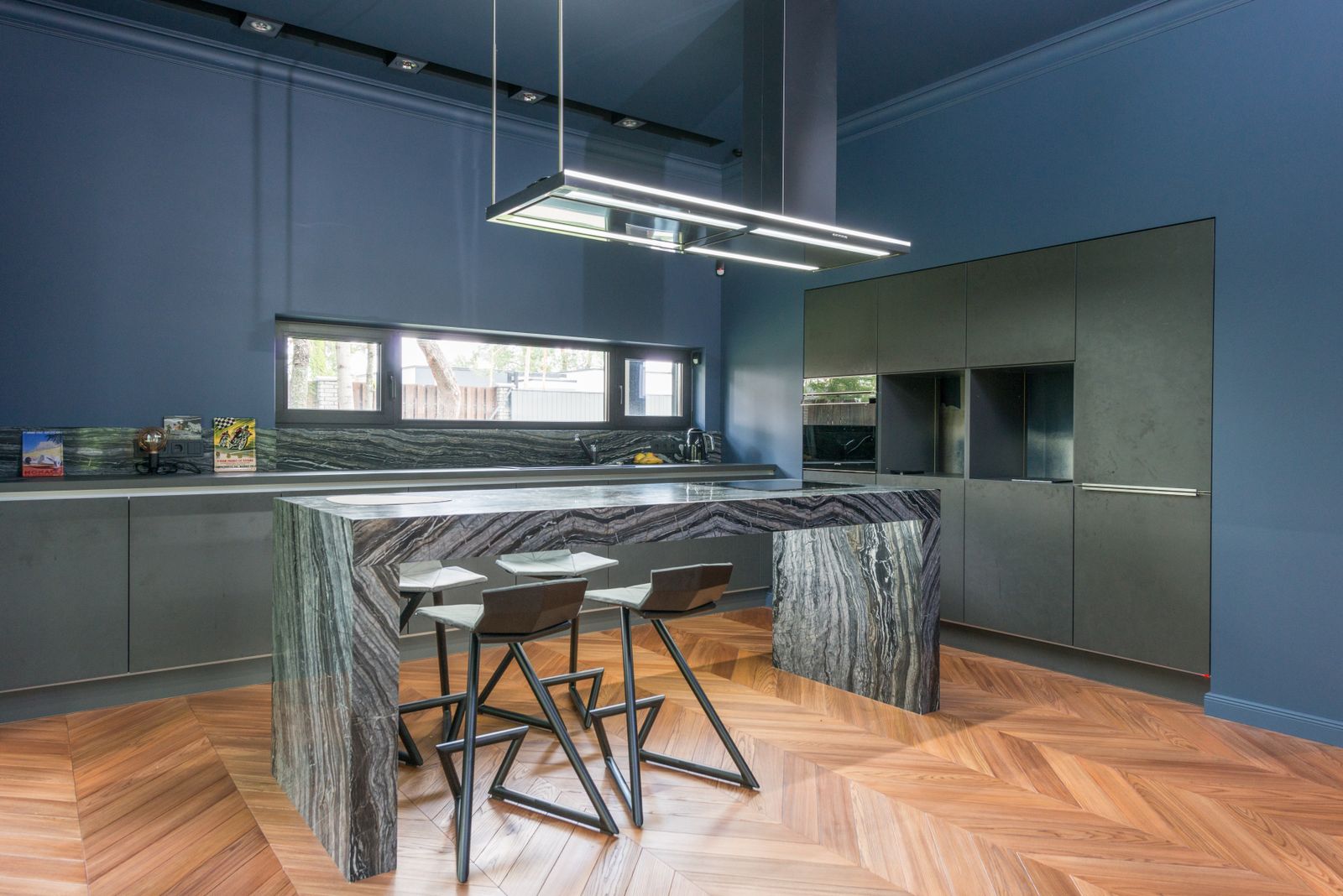
Granite. The default outdoor counter. Heat-resistant up to about 1,200°F, scratch-resistant, and sealed once a year it shrugs off oil and wine. Costs $60 to $120 per square foot installed. Choose a darker granite over a light one — lighter granites show oil stains as dark spots that don't always come out. Honed finishes hide the wear better than polished.
Quartzite. A natural stone harder than granite and more expensive. Costs $80 to $180 per square foot installed. Holds a polish that lasts decades. Best for serious outdoor kitchens where the budget can absorb the line item.
Tile (porcelain). A 12 to 24 inch porcelain tile (Daltile, MSI, Bedrosians) at $8 to $25 per square foot. The grout is the failure mode; use a 1/16 inch grout line and a urethane grout, never a standard cement grout which stains and cracks in three winters.
Stainless steel. A 304 stainless with a 16-gauge thickness costs $100 to $200 per square foot and looks like a commercial kitchen. Durable, easy to clean, but reflects sun glare into adjacent seating. Best in a covered patio without direct overhead sun.
Skip concrete-poured counters for any climate that freezes. Concrete slabs in outdoor kitchens crack at the seam between sections within 2 to 4 winters, and the repair is a recast of the entire counter.
Layout Patterns
Three layouts cover 90% of residential outdoor kitchens. The choice comes down to traffic flow and how the cook wants to relate to the guests.
Galley. Two parallel runs, one with the grill and the other with the sink and prep. The classic outdoor kitchen pattern in tight 10 by 12 patios. Width between the runs should be at least 48 inches so two cooks can pass each other; less than 42 inches and the cook is hitting the back counter with their hip every time they turn.
L-shape. The grill on one leg, the sink and prep on the other, a corner that fills with a small fridge or a trash pull-out. The most flexible layout and the most common in 12 by 16 patios. The corner is a real design moment — a Kamado grill (the Big Green Egg or the Kamado Joe) or a built-in pizza oven fills it cleanly.
U-shape. The grill on one run, sink on the second, fridge or smoker on the third. Most useful in 16 by 16 or larger patios where two cooks work the same kitchen. The U takes more square footage but separates hot, cold, and wet zones in a way the L-shape can't.
A single-wall layout (everything on one run) handles small patios and tight budgets but creates the worst workflow — every task pulls the cook away from the grill to reach the sink or fridge. We avoid single-wall when the footprint allows.
Plan on 30 inches of counter space next to the grill on at least one side. Less than that and the cook has no landing zone for the hot tools.
Ventilation
Outdoor kitchens are either in open air or under a roof. The two ventilation paths diverge sharply.
Open air. No hood required. The 1,200°F of a 36-inch grill plume rises and dissipates within 6 to 10 feet downwind. Plan the patio orientation so prevailing winds carry smoke away from the seating, not through it.
Covered (pergola, patio cover, full roof). A hood is required. Most local codes call for an exhaust blower of at least 1,200 CFM for a 30-inch grill, 1,500 CFM for a 36-inch, and 1,800 CFM for a 42-inch or larger. The Broan and Best by Broan outdoor hoods in the RMIP series ($899 to $2,499) handle the residential case and ship with a 1,200 to 1,800 CFM blower. A ceiling fan below a covered patio adds another 100 to 200 CFM of clearing capacity.
The ceiling above the grill must be non-combustible or the hood's clearance to combustibles goes from 30 inches down to 36 inches. Most pergolas are not built with this in mind — plan a metal insert or a plaster soffit over the grill if the structure is wood-framed.
Brand Matrix
Weber. The volume leader. The Genesis II S-435 at $1,799 and the Summit S-470 at $3,799 are the gas flagships. The Original Kettle 22 at $169 is the charcoal classic.
Traeger. Pellet-only. The Pro 575 at $899 is the entry; the Timberline 1300 at $3,499 is the workhorse. Their app integration is the deepest in the category.
Napoleon. The closest Canadian competitor to Weber and the better-built option in the same price band. The Rogue 425 at $1,399 holds four burners plus an infrared side burner.
Blaze. The best price-to-quality ratio in the built-in category. A Blaze 32-inch Built-In grill at $1,799 gives the same cooking area as a $3,000 Weber.
Coyote. The mid-market premium. A 36-inch Coyote grill starts at $2,799 and runs up to $5,999 for the combo units. The build quality is a real step up from Blaze.
Hestan. The high end. A 36-inch Hestan gas grill runs $6,999 to $9,999. Worth it for serious cooks; overkill for most households.
A working budget for a 12 by 16 L-shape outdoor kitchen with an L80 granite counter, a Blaze 32-inch grill, a Coyote vent hood, and a small Coyote fridge lands between $13,000 and $22,000 installed in most markets. Add a low-voltage lighting run, a sink with hot and cold water, and a natural gas line for $2,500 to $4,500 more.
The bottom line
Match the grill to the household cooking pattern first — gas for speed, charcoal for flavor, pellet for low-and-slow — then size the counter at 30 inches next to the grill, and put a real hood under anything that sits under a roof.