
The garage is the largest unfinished room in the typical American house, and the most neglected. Most of the ones we walk into share the same four problems: every square foot of floor is spoken for, the walls hold nothing, the ceiling holds almost nothing, and the concrete is permanently dusty because nobody ever sealed it. A few of those problems are solved with a Saturday afternoon and a stud finder. The other few want a Saturday and a budget.
This guide covers the wall systems that earn their keep, the overhead storage math, the cabinet-versus-shelf decision, the floor coatings that hold up under hot tires and road salt, and the brand matrix that runs from $200 weekend projects to $4,000 full-room builds.
Wall Systems: Slatwall, Pegboard, French Cleat
Three wall systems cover 90% of what a homeowner actually hangs. Each solves a different mix of weight, tool type, and flexibility.
Slatwall. Panels of 8-foot-tall, 4-inch-on-center grooved MDF or PVC that lock together. Anything hangs off the slat — hooks, baskets, shelves, bike mounts — without touching a screw. Weight capacity per square foot is 35 to 50 pounds, which is enough for ladders, yard tools, and a kid's bike. The Gladiator GearWall panels ($32 to $48 per 8-foot panel at Home Depot) and the NewAge Pro Series ($38 to $56 per panel) are the two pass-through brands. Order 10% more than the wall's square footage to cover cuts and waste.
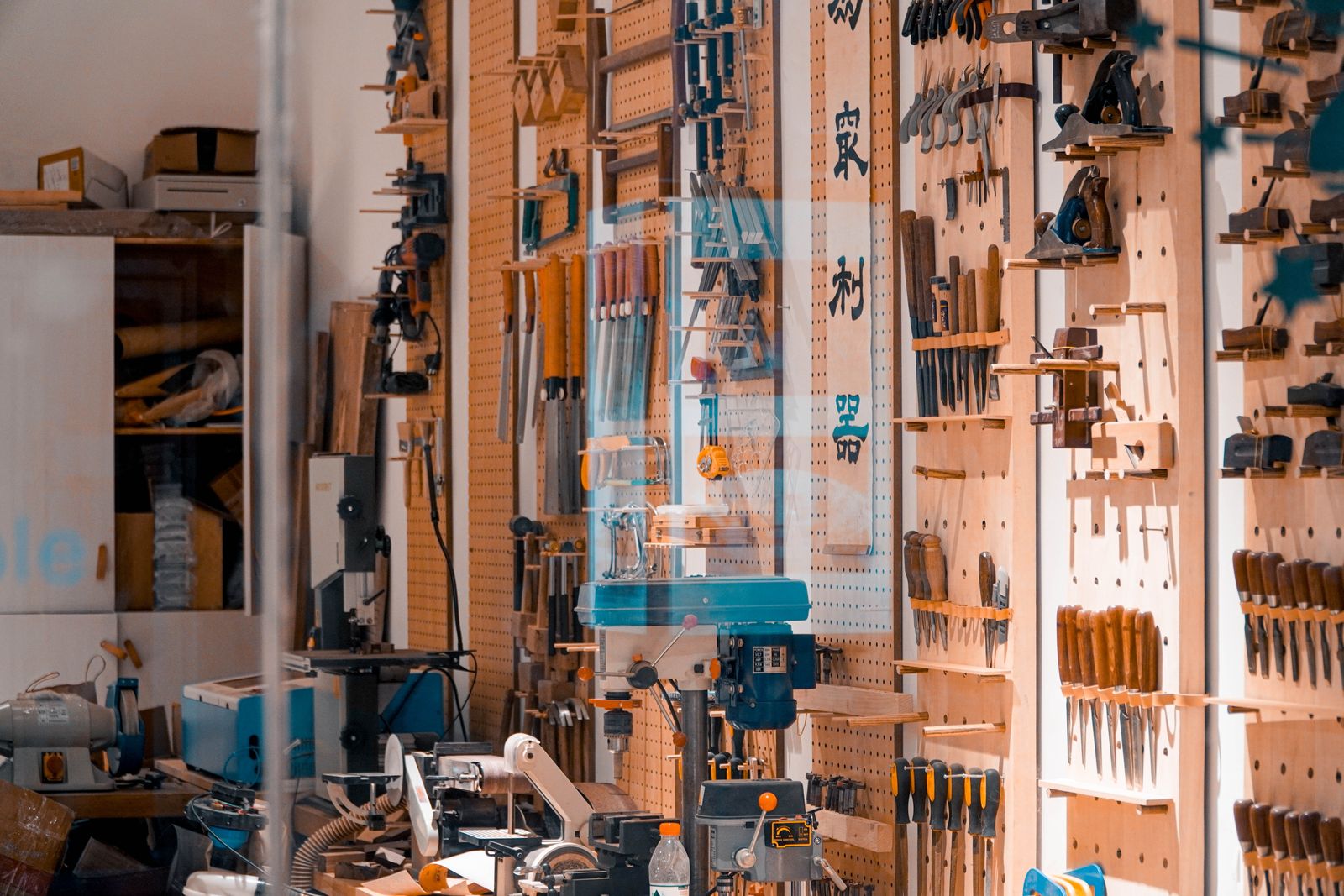
Pegboard. 4 by 8 foot hardboard sheets with ¼-inch holes on 1-inch centers. Lighter (15 to 25 pounds per square foot) and cheaper ($14 to $22 per sheet) than slatwall. Best for hand tools, small parts, and the 200-piece socket set the user reaches for every other weekend. Install with furring strips behind the board so the hooks have clearance behind the panel.
French cleat. Two interlocking plywood strips cut at 45 degrees, one on the wall and one on the back of the shelf or cabinet. The simplest way to mount a custom shelf, a saw, or a heavy bag of fertilizer. Holds 75 to 150 pounds per cleat pair. Most home centers will cut the cleats for free if you bring them a sketch.
For most two-car garages, plan on slatwall on at least one wall, pegboard above a workbench, and one French cleat row for the heavy items. Gladiator and NewAge kits come with all three.
Overhead Storage: Free Up the Floor
Anything stored above 7 feet is invisible most days and that is the point. Overhead racks take advantage of the 3 to 4 feet of dead air between the garage ceiling joists and the bottom of the trusses.
For a standard 2-car garage with 8-foot ceilings and a 7-foot garage door, you have roughly 6 to 12 inches of clearance between the bottom of the rafter ties and the bottom of the garage door tracks. That is enough for shallow, low-clearance storage: plastic bins of holiday decorations, out-of-season clothing, and camping gear.
For 9 to 10 foot ceilings (the more common new-build height), full overhead racks with 18 to 24 inches of hanging clearance become available. Fleximounts' 4 by 8 foot overhead rack ($179 to $249) and the FLEXIMOUNT 4-bike ceiling hoist ($159) are the workhorse picks. The Rakks shelving systems hold up to 600 pounds per linear foot and look like furniture; the entry-point price starts around $390 per 4-foot section.
Weight capacity is the metric worth checking. Most overhead racks are rated between 250 and 600 pounds. Holiday decorations come in well under; tools and bins of books come in over. Don't overload the rack and don't run anything through the ceiling drywall — lag directly into the joists with the included hardware or you'll find the whole assembly on the floor in a year.
Cabinets Versus Shelving
This is the largest single decision and it's mostly about visibility.
Open shelving (the Rubbermaid FastTrack or Husky 5-tier shelving at $79 to $229) costs less, holds more per square foot, and shows you what's there. The downside is every bin has to match or the visual chaos wins. Reserve one wall for open shelving of bulk storage: paint cans, fertilizer, paper towels, dog food.
Closed cabinets (the NewAge Pro Series Steel cabinets at $279 to $599 per unit) cost more, hold less per cubic foot, and hide the mess. The upsides are real: dust stays off the wedding china you're storing for a year, chemicals stay away from small children, and a row of matching cabinets makes the garage look finished.
The hybrid plan. Closed cabinets along the wall where the cars back in (so a fender dent can't trigger a domino), open shelving on the side wall, slatwall on the back wall behind a workbench. This three-wall pattern handles most two-car garages in $1,500 to $4,000 of cabinetry plus shelving.
For modular hardware systems, NewAge Products Pro Series and Gladiator Ready-to-Assemble are the two dominant brands. Rubbermaid's FastTrack and the Kobalt garage system at Lowe's run a step cheaper and ship faster. Husky is Home Depot's house brand and represents the strongest entry-level price point.
Concrete Floor Coatings
Bare concrete is dusty, porous, and ugly in the way nobody admits out loud. The two coating paths are epoxy and polyaspartic.
Epoxy. Two-part epoxy (one of the Rust-Oleum EpoxyShield kits at $150 to $225 for a 2.5-car kit) bonds to properly prepped concrete and gives a glossy, durable finish. The application is a weekend if you follow the etch-and-prime instructions. The finish lasts 5 to 10 years under light use. Hot tires parked in the same spot eventually lift the coating in tire-shaped patterns — this is called "hot-tire lift" and it's the most common failure.
Polyaspartic. A 1-day-coat polyaspartic (what the pros at Penntek and Garage Force apply) costs $5 to $9 per square foot installed, but cures in 24 hours and resists hot-tire lift. Most polyaspartic jobs come with a lifetime warranty against hot-tire lift and a 15-year warranty against yellowing.
The floor prep is the same in either case: a diamond grinder or an etch-and-rinse, a clean substrate, and a dry day above 50°F. Skipping the prep is the cause of 90% of failed garage coatings. A $300 rental diamond grinder from Home Depot is the difference between a 3-year floor and a 10-year floor.
For a 2-car garage, a DIY epoxy runs $300 to $500 in materials. A professionally installed polyaspartic runs $1,800 to $3,200. The numbers tip toward pro installation once the garage is over 500 square feet because the labor cost savings on a weekend project are eaten by the time.
A Practical Layout
For a 20 by 22 two-car garage, here's the plan we'd build out for $2,000 to $3,500 in storage plus $1,800 to $2,800 in floor coating.
- Back wall: 8 feet of Gladiator GearWall panels with hooks for the leaf blower, yard tools, and extension cords. A 4-foot French cleat row above the workbench for the heavier items.
- Side wall (1): 8 feet of NewAge Pro Series steel cabinets in 24-inch depth. Base cabinet height 36 inches, upper 30 inches. Five cabinets at $349 each = $1,745.
- Side wall (2): 8 feet of Rubbermaid FastTrack open shelving, 5 tiers, 24 inches deep. Holds the bulk goods. $229.
- Ceiling: Two 4 by 8 overhead racks from Fleximount, each rated to 450 pounds. $199 each = $398.
- Floor: Polyaspartic in a tan or slate gray flake pattern. $2,200.
Total: roughly $4,500 to $5,500, depending on the floor choice and the work done in-house.
Workbenches and Task Lighting
The workbench earns a spot of its own because it is the only garage fixture the user reaches for every single day. The workbench should be 28 to 36 inches deep (30 inches is the standard depth of a 24-inch-deep base cabinet plus a 4 to 6 inch backsplash), and 60 to 96 inches wide depending on the wall. Height should match the user's elbow height, just like a standing desk — most adults are comfortable at 36 to 38 inches; bench seat heights (32 inches) are for fine-detail work like guitar repair.
The Husky 52-inch welded steel workbench at $329 and the NewAge 72-inch pro workbench at $549 handle the workhorse category; both ship with a 1.5-inch-thick hardwood top, a lower shelf, and a 600 to 800-pound capacity. The Gladiator modular workbench line at $279 to $899 runs lighter and cheaper but takes 60 to 90 minutes to assemble.
Above the workbench, plan the lighting to hit 75 to 100 foot-candles at the work surface. The standard 4-foot LED shop light from Hyper Tough or Barrina ($25 to $45 each, daisy-chainable) puts out 4,000 to 8,000 lumens across 4 feet. Two of them mounted at the workbench ceiling produce even coverage at 50 to 75 foot-candles. A small task light on a swing arm (the Husky 40-LED at $39 or the DEWALT DCL079 at $199 cordless) puts focused light on the immediate work area.
Storage underneath the workbench is the most-overlooked zone. A row of 12 to 16 inch deep drawers on full-extension slides (the NewAge 4-drawer base at $329, or the Husky 5-drawer at $279) carries the small parts the user reaches for 30 times a day. The Husky tool chest at $249 to $499 sits on the right side of the bench and locks; the bolt bin is on the left.
A pegboard back on the wall behind the workbench holds the daily hand tools. A 4 by 8 foot hardboard sheet (Home Depot cuts these for free) plus 50 to 100 hooks and bins at $1 to $4 each runs $30 to $80 in materials.
The bottom line
Treat the walls and ceiling first because the floor is the most expensive square foot you own; a slatwall-and-overhead baseline covers 70% of the parking-space problem before you spend a dollar on a cabinet.