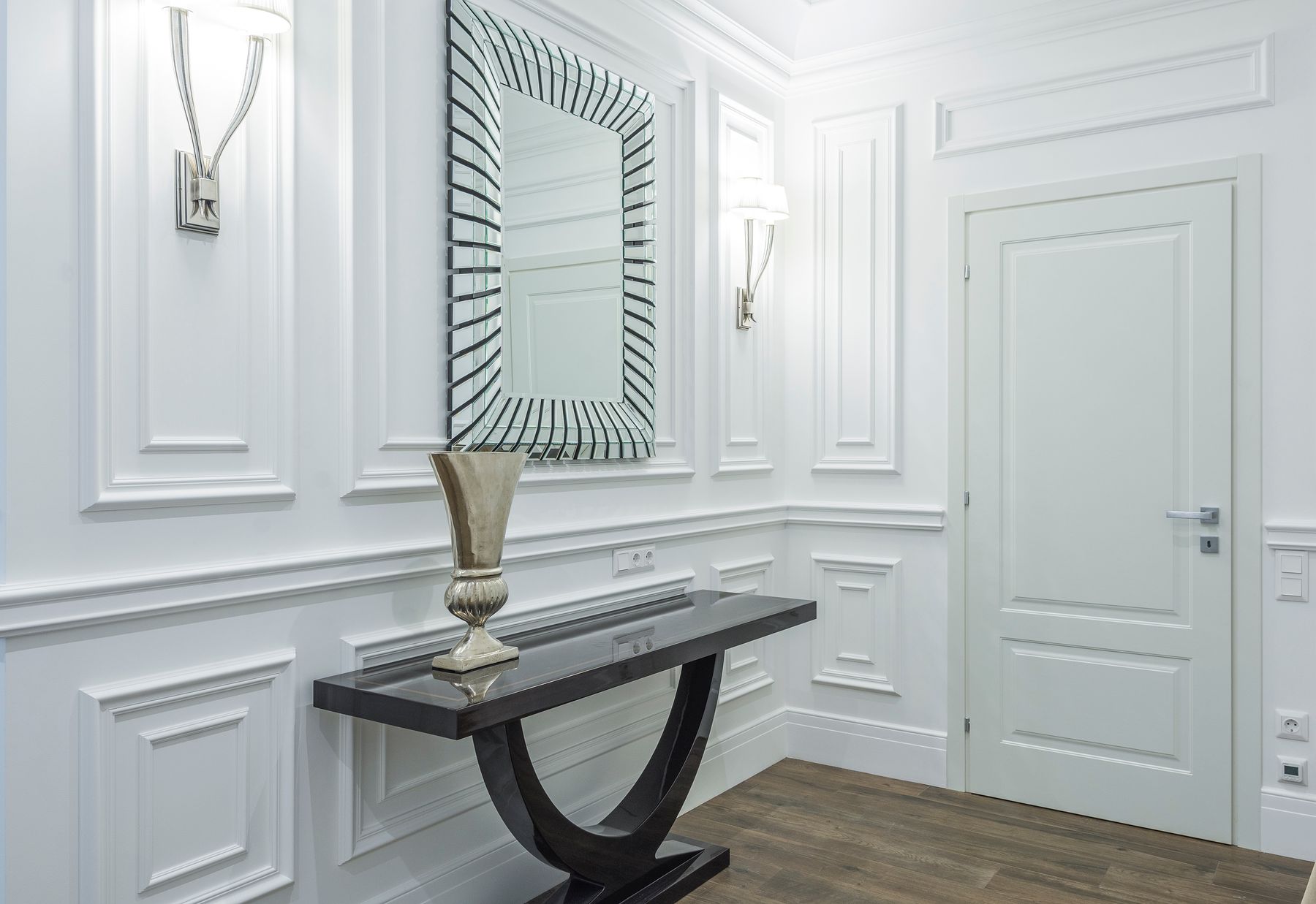
The entryway is the most under-designed square footage in most homes. It is also the most used — every coat, every shoe, every gym bag, every leash, every set of keys passes through it twice a day, whether it deserves the attention or not. We see the same failure pattern again and again: a flat console table, maybe a mirror, and a slow-motion avalanche of objects creeping down the hallway. The fix is not more surface; it is a layered system of vertical, hidden, and surface storage that matches how the household actually behaves.
This guide walks through the storage types that work in a real entryway, how to combine them, and how to budget for an entryway that handles everything from a single commuter to a family of five.

The Entryway Workflow: Three Drop Zones, Not One
We think of entryway storage as three overlapping zones. The first is the immediate drop zone — a height of about 30 to 48 inches off the floor, where the hand reaches the moment the door closes. Wall hooks, a shallow ledge, and a key bowl live here. The second is the seated zone — somewhere between 16 and 18 inches up, which is bench height. Shoes come off here, and bags get set down before they ever reach the couch. The third is the hidden zone — closed baskets, drawers, or cabinets below the bench or behind a console — where the stuff that should not be visible goes to die.
If you hit all three zones, the entryway carries itself. Skip any one and the system collapses within a week. Hooks without a bench means back strain and bags on the floor. A bench without baskets means shoes spread out in a galaxy under the seat. A console without hooks means jackets draped over chairs.
Consoles: The Workhorse
A console table is the easiest first purchase. Even a 36-inch-wide console buys you a place to put a tray for keys and a spot for a lamp or vase. Most quality consoles from West Elm, CB2, Crate & Barrel, and Pottery Barn land between $249 and $799. The West Elm Mid-Century Console at $349 is a common pick — 48 inches wide, two lower shelves, and a slim profile that does not block the walkway. The CB2 Cement Console starts at $499 and weighs about 90 pounds, which makes it useful in a household where the console is also a leaning surface.
For tighter widths, look at the IKEA Hemnes console (around $129) or the West Elm Parsons (around $249). Both have a lower shelf for baskets and a top surface for active drop items. The classic mistake is buying a console without drawers — anything without a drawer means the console becomes a magazine pile inside three weeks. If the budget allows, spend the extra $100 to $150 for one with at least two drawers. The Crate & Barrel Tidewater console ($649) and the West Elm Harmony console ($549) both have soft-close drawers and a bottom shelf, which is the right combination.
Depth matters as much as width. Most hallways cannot handle a console deeper than 16 inches without blocking the door swing. A 12- to 14-inch-deep console is the sweet spot for a standard 36- to 42-inch-wide hallway. Measure the door arc before you order anything.
Benches: Where Shoes Live
A bench is the piece that changes the entryway from a hallway into a mudroom. Heights vary between 16 and 18 inches for a standard seat. Depths run 14 to 18 inches, with the deeper ones — like the West Elm Penelope Storage Bench ($549 to $749) or the Crate & Barrel Bench ($499 to $699) — able to double as a perch for putting on boots.
Lifted benches — anything with at least 4 inches of clearance from the floor — let shoes slide underneath. Lifted benches with a shelf are even better: the shelf can hold two pairs of flats or one pair of boots. Look for lifters like the IKEA TRONES shoe cabinet ($60 per pair) or the CB2 Peekaboo Bench ($399), both of which combine a lift, a shoe shelf, and a closed cabinet.
For households with kids, the best move is a deeper bench at least 18 inches deep and 48 inches wide, so two children can sit side by side. The Schoolhouse Utility Bench ($649) and the Land of Nod Elementary Bench ($429) were designed for this exact use. If you want to keep the budget under $300, the IKEA HOLMSUND ($249) works, and the threshold between bench and cabinet doubles as a boot ledge.
Baskets: The Hidden Half of Everything
Baskets are the unsung workhorse of entryway storage. A pair of 18-inch-by-14-inch baskets under a bench can hold four pairs of shoes each. A larger 22-by-16 basket can hold a week of dog leashes, gloves, scarves, umbrellas, and the random paper pile that arrives at the front door.
For natural baskets, the threshold pricing is around $30 to $60 each at Target, World Market, and HomeGoods. The Serena & Lily Seagrass Storage Basket runs $89 to $129 and ages into a much better look over time. For a more durable family option, the IKEA KUGGIS ($19 each) or the CB2 Rattan Bin ($79 each) handle boots, gym shoes, and pet gear without losing shape.
The rule we follow: every entryway needs at least one basket per family member, plus one shared overflow basket. A household of four living with only two baskets will always overflow.
Wall Hooks: The Vertical Payback
If there is one storage move with the best return per square foot, it is wall hooks. A 36-inch row of hooks at 60 inches off the floor holds the same number of bags and coats as a full coat closet, takes no floor space, and costs between $20 and $80.
Look for hooks with a backplate that spreads the load across at least two drywall anchors — single-screw hooks pull out when loaded with a winter coat. The CB2 Triple Hook ($24 to $36 per hook) and the Schoolhouse Utility Hook ($28) are both reliable. For tighter budgets, IKEA's LANEBERG and HUGAD lines run $5 to $9 per hook.
Height matters here too. Hang hooks at 60 to 66 inches so a coat hangs without dragging on the floor, but leave room for kids' hooks at 42 to 48 inches if children share the entryway. A combination of adult-height and kid-height hooks across one wall is the most useful version of this idea.
Drop Zone Furniture: When the Entryway Is Really a Mudroom
For larger entryways — anything over 7 feet long, or with a dedicated closet niche — a true drop zone pays off. The classic IKEA PLATSA configurations ($300 to $800 total) combine a bench, hooks above, baskets inside, and often a small shelf for keys. The Pottery Barn Modular Mudroom System ($1,200 to $3,500) and the West Elm Mid-Century Modular Entry ($900 to $2,200) take the same idea and finish it out in solid wood.
The benefit of a built-in drop zone is that the storage maps the exact motion: bag down, coat up, shoes over, keys in tray. Once the family develops the muscle memory — usually within two weeks — the entryway stops being the household's biggest mess.
Apartment-Friendly Entryways
Apartments without a real entryway can still use most of these ideas. A 30-inch-wide wall between the door and the hallway is enough for a 14-inch-deep console with three hooks above and one basket below. The IKEA RAGRUND ($25) and HEMNES ($129) are both apartment-friendly depths.
Over-the-door organizers are an underrated move — they hang eight pockets of storage over a door without using floor space. The Whitmor Over-the-Door Organizer ($20 to $40) holds mail, leashes, hats, dog treats, and scarves. For renters who cannot drill, 3M Command hooks (around $7 for a six-pack) hold light jackets and totes at up to five pounds per hook. For heavier coats, the Over-the-Door Coat Rack with Hooks ($45 to $80 from Bed Bath & Beyond) covers most apartment needs.
A slim shoe cabinet fits where a console cannot. The IKEA TRONES ($60 per pair) is 7 inches deep and fits eight pairs of shoes in two rows. The CB2 Slim Shoe Cabinet ($549) holds 12 pairs, has a closed face, and barely reads as furniture.
Budgeting the Entryway: A Real Breakdown
A reasonable, middle-of-the-road budget for a real family entryway runs $800 to $2,500. Here is what the typical spend looks like:
- Console with drawers: $249 to $649 (West Elm Parsons at $249, Crate & Barrel Tidewater at $649).
- Bench or bench-cabinet: $249 to $549 (IKEA HOLMSUND at $249, West Elm Penelope at $549).
- Wall hooks (three to five): $40 to $150 (CB2 and Schoolhouse combined).
- Baskets (three to five): $90 to $300.
- Mirror: $100 to $400 (IKEA HEMNES at $129, West Elm Modernist at $399).
- Tray, key bowl, lamp: $40 to $120.
- DIY install and paint touch-up: $50 to $150.
A single-person budget with no big-ticket items can land closer to $400: a $129 console, a $60 shoe cabinet, $80 in hooks, $90 in baskets, and $40 in trays. A two-parent family with three kids and a dog realistically needs the $2,500 plan plus a closet reorganization worth $300 in hooks and bins.
Common Mistakes to Skip
The biggest mistake is forgetting footwear. An entryway with hooks and a console but no basket or shoe cabinet will have a permanent shoe drift down the hallway. Plan shoe storage at the same time you plan coat storage.
The second biggest mistake is buying upholstered furniture in a true entryway. A fabric bench near an exterior door absorbs dirt, water, salt, and snow. If you want fabric, choose a performance fabric or plan on a washable cover. Leather, treated canvas, and outdoor-rated fabrics all survive.
The third is hanging hooks too high. Anything above 72 inches is hard for anyone 5'6" or shorter to reach without a step stool. Children and shorter adults lose daily access, and the system quietly stops being used.
The fourth is forgetting lighting. Most entryways are underlit, which makes an organized space read as cramped. A single sconce or a $100 lamp on the console changes the entire feel.
Designing for the Daily Reality
The best entryway designs we see share three qualities. They hit all three zones — drop, seated, hidden — without exception. They use a mix of open hooks and closed baskets so visual clutter hides. And they are sized to the actual use: a 6-foot-wide hallway needs a 36- to 48-inch console, not a 60-inch sideboard that blocks the path.
If you start with a single piece — a console with a drawer and a row of hooks above it — and add one storage type every month, the entryway will compound. Six months in, you have a system that runs itself.
The bottom line
Layered storage wins: hooks at hand height, a bench at seat height, baskets below, and a console with a drawer for the daily grind. Buy the size your hallway actually holds, plan shoe storage before coat hooks, and stick to outdoor-rated materials if the entryway opens to the outside.