
The dining table is the hardest-working piece of furniture in the house. It holds homework and laptops at 7 a.m., work calls at 11, dinner at six, puzzles at eight, and a half-folded load of laundry somewhere in between. Most buyers regret their table within a year. We see the same five regrets over and over: too big for the room, too small for the household, wrong shape for the traffic flow, surface that stains on contact, or chairs that scrape the floor every time someone pushes back. The fix is a small set of measurements taken before anything ships, plus a clear picture of how the table will be used.
This guide walks through shape selection by room geometry, the sizing math, the seating math, the four materials that earn their keep, and a real brand matrix that holds up under daily use.
Shape by Room Geometry
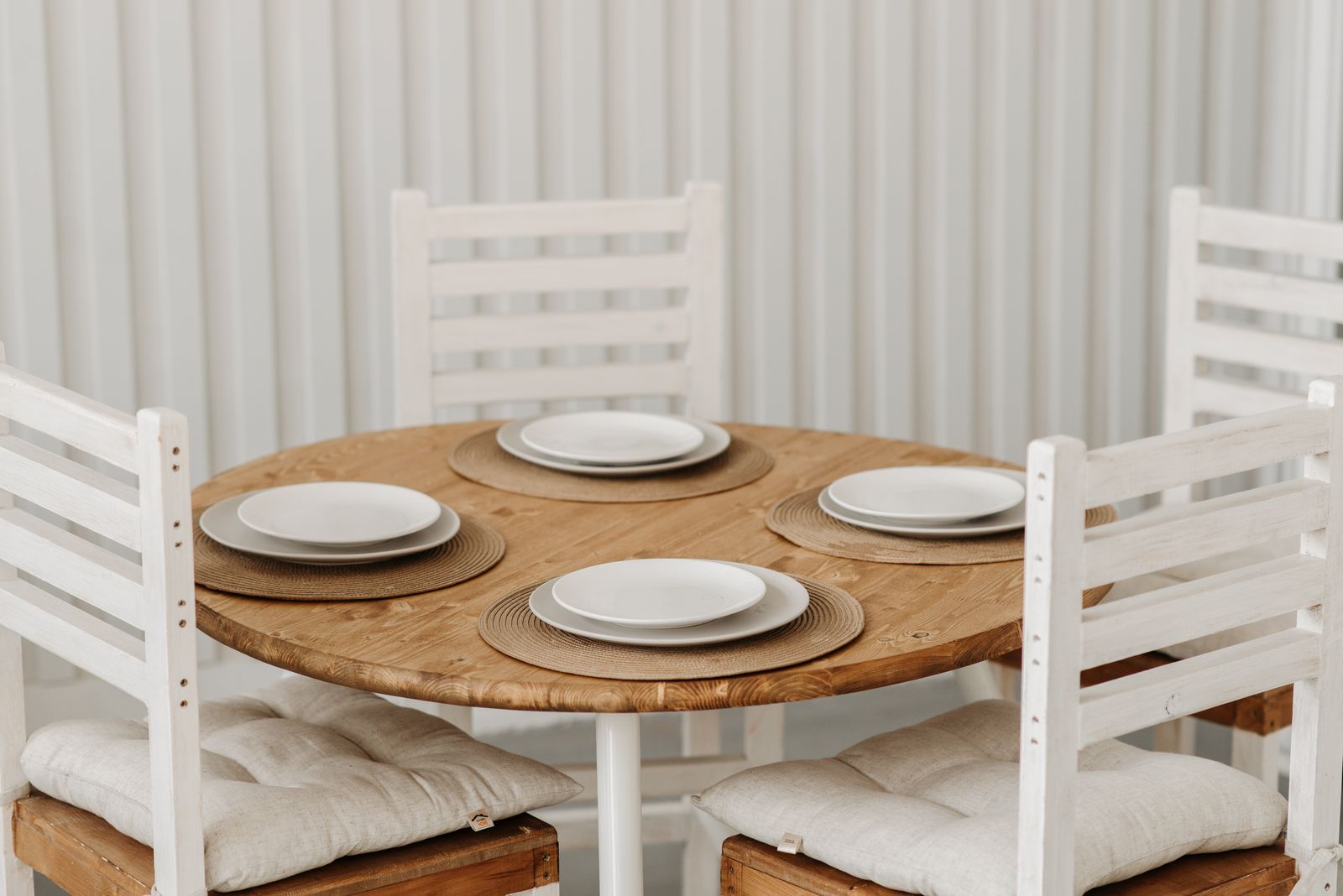
Rectangle, round, square, and oval each solve a different problem. Rectangle is the default and the most flexible: it seats the most people per square foot, fits against a wall or under a pendant, and pairs with a bench on one side for a teenage crowd. Round tables are conversation-first and traffic-first — they seat four to six in the same square footage, no one sits at a corner, and chairs pull out without hitting a wall. The catch is round tops don't extend cleanly past 60 inches without a center base getting in the way of knees.
Oval tables are rectangle tables with the corners cut off. That detail matters more than it sounds. An oval's longer dimension holds more people than a circle of the same width, and there are no sharp corners to bruise shins on a tight pathway. Squares are the rarest — they look composed in a square room but seat only four to six even at 54 inches. Above 60 inches the table becomes a small dance floor.
For a room that's 10 by 10 feet, anything over a 48-inch round or a 60-inch rectangle crowds the chairs. For a 12 by 14 room, a 72 by 40 rectangle or a 60-inch round is the right ceiling. For a 14 by 16 room or larger, a 96-inch rectangle or a 72-inch round can carry eight comfortably.
Sizing Math
The rule that keeps every dining layout from feeling cramped is 36 inches of clearance behind each chair. Less than that and diners bump the wall or the buffet every time they stand up. More than 48 inches and the room starts to feel like a cafeteria. So if the chair is 20 inches deep and you need 24 inches behind a seated diner for elbows plus 36 inches of walkway, that's 80 inches total from the wall to the table edge. A room that's 12 feet wide can carry a 60-inch-wide table comfortably; a room that's 10 feet wide cannot.
Table height is standardized between 28 and 30 inches and almost never an issue. What matters more is the apron — the structural beam that runs under the tabletop just below the edge. An apron of 2 to 3 inches preserves knee clearance for adults. Aprons of 5 inches or more (common on farmhouse tables from Pottery Barn and Restoration Hardware) eat into knee room and make a chair-with-arms impossible.
Allow 24 inches of table edge per person as a floor, 28 inches as comfortable, and 30 inches as generous. A 72-by-40-inch table with both ends and both sides in use gives you 8 of those 24-inch slots; a 96-by-44 table holds 10. Bench seating adds roughly 30% capacity to the same table because benches tuck fully under the apron when not in use.
Seating Math
Chair width is the metric nobody tracks until the chairs arrive. The standard dining chair is 18 to 20 inches wide. Apartment-grade chairs from CB2 and Article often land closer to 18 inches; armchair dining chairs from Pottery Barn and Restoration Hardware can be 22 to 24 inches. That difference alone changes a six-seat table into a four-seat table in the same footprint.
Armless chairs save roughly 4 inches per seat over armed chairs. They also slide fully under the table, which makes the room look bigger when the table is not in use. The trade-off is comfort over a long dinner — an armed chair supports the elbow through a two-hour meal in a way a side chair does not.
Banquettes solve a different problem. A built-in banquette along a wall can seat three adults in the linear feet that two chairs on the same wall would require, and the back cushion lets you skip the chair back entirely. The catch is permanence — once a banquette is in, the dining zone is in. Article's Sven or the West Elm Andrée modular line can fake a banquette look without the cabinetry.
Wood: The Honest Material
Wood carries the broadest design vocabulary and forgives the most mistakes. A solid wood table from Room & Board, West Elm, or Crate & Barrel in oak, walnut, or ash will outlast a decade of daily dinners if the finish holds. Expect to pay $1,295 to $2,495 for a solid-wood top in the 60 to 72 inch range. Engineered wood with a wood veneer (what most sub-$1,000 tables use) looks the same on day one but telegraphs the wear by year three — peel the finish and there's particleboard underneath.
Wood's two failure modes are heat and water. A trivet under a Dutch oven and a coaster under a water glass go from optional to mandatory within a week. Re-oil every 12 to 18 months with the manufacturer's recommended product (most West Elm and Article tables ship with a maintenance kit) and the surface will patina rather than split.
Stone and Marble: The Statement Materials
Marble and quartzite tables turn a dining room into a photograph. They also scratch, etch, and stain in ways no one warns you about. A slice of lemon left overnight on a Carrara marble top leaves a dull mark that takes a refinish to remove. Honed marble hides the etch; polished marble shows every glass ring.
Quartz and porcelain tops (what CB2 sells under the Cosmo line, and what Article calls "concrete-look sintered stone") give the same visual without the upkeep. They are heat-resistant up to about 300°F, won't etch from acid, and hold up to a child's juice spill without a stain. The price lands in the $1,895 to $3,495 band for a 72-inch top on a metal or solid wood base.
Stone is heavy. A 72 by 40 marble top can weigh 250 to 350 pounds. If the table moves for any reason — cleaning, party season, a renovation — plan on four adults and a furniture dolly. Apartment dwellers should think twice.
Glass and Metal: The Light Weights
Glass tops disappear visually and let the rug and chairs do the talking. Tempered glass is the only grade worth buying; clear glass scratches and fogs within a year. Most glass dining tables have a single base, often a pair of crossed metal legs or a chrome pedestal. The clarity comes at a cost: fingerprints, water rings, and dust are visible from across the room. A microfiber pass before dinner is a real chore, not a decorative detail.
Metal base tables — what Restoration Hardware calls "industrial" and what CB2 calls "modern loft" — pair a wood or stone top with blackened steel or brushed brass legs. The base tends to be the most durable part of the table because the top is the part that gets replaced when tastes change. A 72-inch table with a steel base and an oak top from Room & Board's Pratt line lands around $1,895; the same look in a Rejuvenation or Article version runs closer to $1,495.
Brand Picks, By Budget
Under $1,000. The IKEA tables in the $249 to $749 band (Ekedalen, Norden, Ingatorp) are honest furniture at a stripped price. The finish won't fool anyone and the construction is engineered wood with veneer tops, but the proportions are correct and the warranty is real. Article's Plura line starts at $899 for a 71-inch solid acacia top.
$1,000 to $1,500. The West Elm Mid-Century Dining Table at $1,295 is the most-bought solid-wood table in the U.S. for a reason — kiln-dried sustainable wood, a 72 by 38 top, and a Honey or Pecan stain that pairs with most chairs. The CB2 Parson at $1,099 runs 74 by 41 and ships in three weeks.
$1,500 to $2,500. The Crate & Barrel Bayside at $1,799 (72 by 40, solid ash, satin finish) and the Room & Board Morrison at $2,295 (72 by 40, solid walnut) are the upper end of the workhorse tier. The Pottery Barn Benchwright Extending Table at $2,199 holds six closed and eight open.
Above $2,500. Restoration Hardware's metaldark reclaimed-wood pieces ($3,200 to $6,800) and Room & Board's solid walnut or white-oak custom tops ($3,500+) are heirloom-grade and ship in 8 to 14 weeks. The price gap is mostly labor and finish, not material.
The bottom line
Buy the smallest table that holds the maximum number of guests you host more than twice a year, then spend the difference on chairs you can sit in for two hours without shifting.