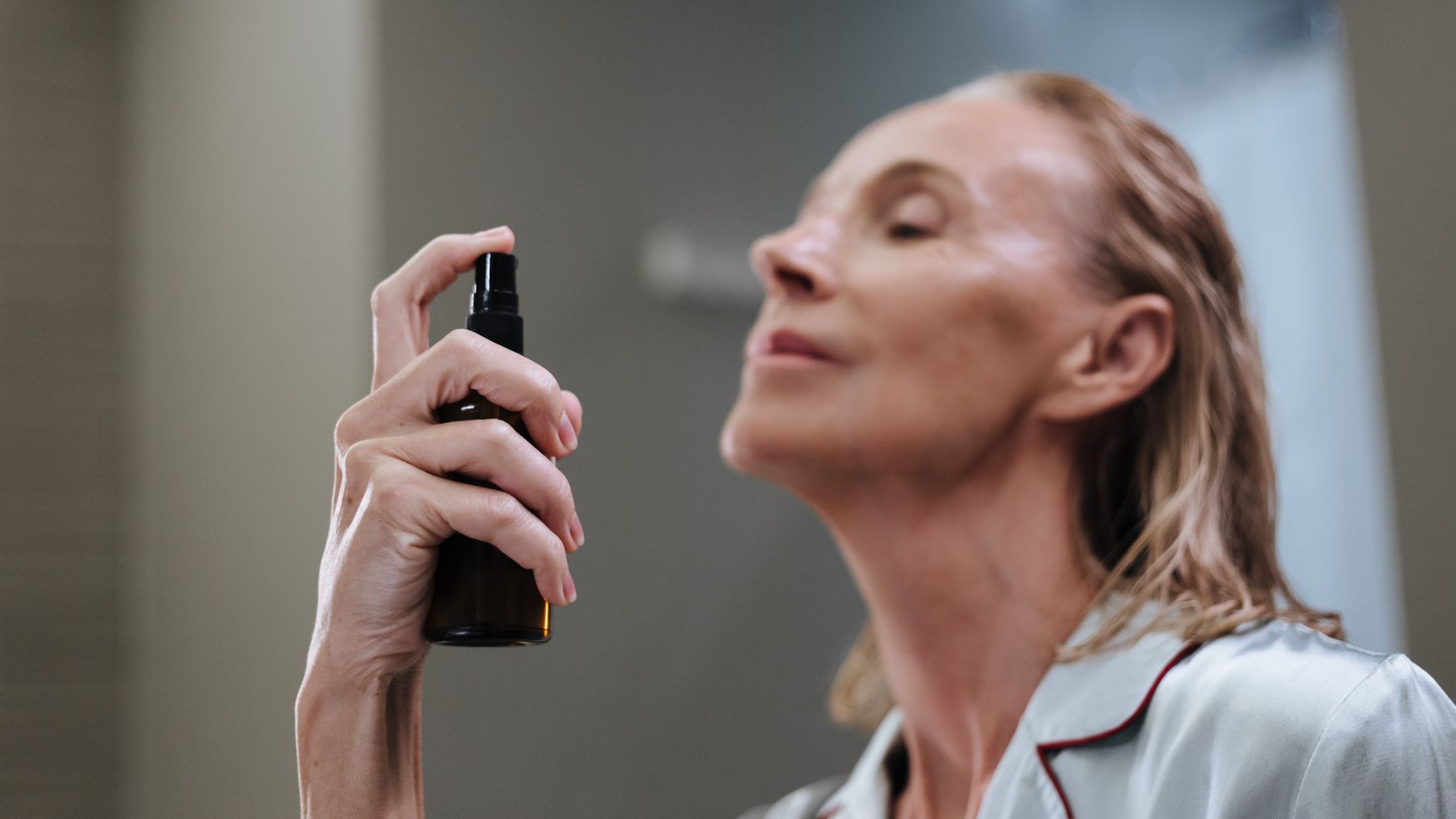
Anti-aging is the most over-marketed category in skincare and the one where the gap between evidence and claims is widest. We surveyed the clinical literature, ranked ingredients by the strength of evidence behind them, and built a layered framework that works across decades without spending hundreds per month.
The headline: four ingredients do most of the work. Everything else is supplementary, and most of it is optional. The routine is shorter than the marketing suggests, and the cost is lower than the prestige counter implies.
The four ingredients with real evidence
After reviewing dozens of clinical trials, four ingredients consistently show measurable, reproducible results for skin aging. They are not interchangeable — each works on a different mechanism, and combining them produces better results than any single one.
Retinoids (retinol, retinal, tretinoin, adapalene): the strongest anti-aging ingredient available. A 2007 study in Archives of Dermatology showed 0.4% retinol reduced fine lines and wrinkles after 24 weeks. Multiple trials show increased collagen production, faster cell turnover, and improved pigmentation. Tretinoin (the prescription form) has the most evidence; retinaldehyde is the most effective over-the-counter option, sitting closer to tretinoin in conversion efficiency than retinol does.
Vitamin C (L-ascorbic acid at 10% to 20%): the strongest topical antioxidant, with clinical evidence for UV protection, collagen stimulation, and pigmentation reduction. The $90 SkinCeuticals CE Ferulic is the textbook formulation — L-ascorbic acid 10%, vitamin E, ferulic acid — and the patent on the combination gives it the strongest evidence base. Lower-cost formulations with similar percentages work comparably once formulated correctly.
Sunscreen (broad-spectrum SPF 30 or higher): the most important anti-aging product. UV exposure causes about 80% of visible facial aging according to a 2013 review in Clinical Interventions in Aging. Daily SPF 30 reduces photoaging measurably over five years compared to intermittent use. The active ingredient matters less than consistent use. The $15 EltaMD UV Clear SPF 46 and the $14 La Roche-Posay Anthelios SPF 50 are workhorse options.
Peptides (palmitoyl pentapeptide, copper peptides, matrixyl 3000): a broader category with mixed evidence. Some peptides — particularly copper peptides and palmitoyl pentapeptide — show measurable improvement in firmness and wrinkles in clinical trials, though the evidence is weaker than for retinoids. The strongest data is for peptides combined with other actives, not peptides alone.
These four — retinoids, vitamin C, sunscreen, peptides — cover the core of evidence-based anti-aging. Everything below is supportive.
What does not work (or has weak evidence)
Several ingredients common in anti-aging marketing have weak or no clinical evidence:
Collagen in creams. Topical collagen cannot penetrate the skin — the molecules are too large. The hydrating effect people notice is from the humectant base, not from collagen absorption. Hydrolyzed collagen has slightly smaller molecules but still does not reach the dermis where collagen production happens. Oral collagen supplements have weak evidence for skin effects; the molecules are mostly broken down in digestion.
Hyaluronic acid in heavy creams. Hyaluronic acid works as a humectant — it pulls water into the surface. This produces short-term plumping. It does not stimulate collagen production or change skin structure long-term. The $28 CeraVe Moisturizing Cream contains hyaluronic acid and works as a moisturizer; it is not an anti-aging active.
Most "anti-aging" botanicals. Lavender, rosehip, argan, and dozens of other botanical extracts show antioxidant activity in petri dishes but inconsistent results in human skin. The concentrations needed for measurable effects are higher than most products contain.
Stem cells. Plant stem cells cannot become human skin cells. The marketing is misleading. Human stem-cell-derived actives (growth factors) have some evidence, but the science is early and the products are expensive.
DNA repair enzymes. Photolyase and similar enzymes show promise in early trials but the evidence is not yet strong enough for routine recommendation. The $90 Dr. Dennis Gross SpectraFace is one of the few products that includes these ingredients at meaningful concentrations.
Gold, platinum, and pearl. Decorative, not functional. The $90 gold-infused creams contain trace amounts that produce no measurable skin effect.
Layering by decade
The right anti-aging routine depends on age, not on trends. Here is the framework we built, organized by decade.
20s: prevention and barrier
The skin at 25 is producing collagen at full capacity. The job in this decade is to maintain what is there and prevent damage. The minimum effective routine:
Morning: gentle cleanser (or water), vitamin C serum (10% to 15% L-ascorbic acid or a stable derivative), moisturizer, broad-spectrum SPF 30.
Evening: cleanser, retinol 0.025% to 0.06% twice a week, moisturizer.
Total: four products, $50 to $100 total. The $14 La Roche-Posay Toleriane Sensitive cleanser, the $30 CeraVe Resurfacing Retinol Serum, the $42 The Ordinary Ascorbic Acid 8% + Alpha Arbutin, and the $15 EltaMD UV Clear cover the core.
The 20s are also when retinoid introduction is easiest. Starting low and slow builds tolerance that pays off in the 30s and 40s.
30s: cell turnover and pigmentation
Cell turnover begins to slow around age 30. Pigmentation from sun exposure starts to show. Fine lines may appear at the corners of the eyes and around the mouth.
Adjustments from the 20s routine: increase retinol frequency to every other night, consider stepping up to 0.1% if tolerated. Add niacinamide 10% in the morning for pigmentation. Add a peptide serum in the evening if fine lines are visible.
Recommended products: $30 CeraVe Resurfacing Retinol Serum (or upgrade to $30 The Ordinary Retinol 0.5% in Squalane), $14 The Ordinary Niacinamide 10% + Zinc 1%, $30 The Ordinary Multi-Peptide + HA Serum.
40s: collagen and firmness
Collagen production drops about 1% per year after 40. Cell turnover continues to slow. Texture lines deepen. The 40s are when retinoid strength matters most.
Adjustments from the 30s: increase retinol strength to 0.3% to 0.5%, frequency to nightly if tolerated. Add a retinaldehyde product (more effective than retinol at the same percentage). Consider a prescription tretinoin from a dermatologist for the strongest evidence-based option.
Add: an AHA exfoliant (glycolic acid 5% to 7%) once or twice a week for texture. The Ordinary Glycolic Acid 7% Toning Solution ($16) works well.
Recommended products: Paula's Choice Clinical 0.3% Retinol + 2% Bakuchiol ($58), prescription tretinoin $30 to $90 with GoodRx, $90 SkinCeuticals CE Ferulic in the morning.
50s and beyond: barrier and hydration
The 50s bring hormonal changes that affect skin differently. Estrogen decline reduces collagen production further and slows barrier repair. Hydration becomes more important. Some retinoids become harder to tolerate due to drier skin.
Adjustments from the 40s: keep retinoid strength but drop frequency if irritation shows up. Add ceramides and richer moisturizers. Consider bakuchiol as a retinol alternative on nights when the skin is sensitive.
The RoC Retinol Correxion Sensitive line ($28) and the $40 La Roche-Posay Cicaplast Baume B5 (barrier repair) become more relevant.
For all decades: sunscreen is the constant. The single most predictive variable for how skin ages is cumulative UV exposure. Daily SPF 30 with reapplication every two hours when outdoors does more than any combination of actives.
The cost of working anti-aging
A pragmatic, evidence-based routine by budget:
Minimal ($50 to $100 total): $13 CeraVe cleanser, $30 CeraVe Resurfacing Retinol Serum, $42 The Ordinary Ascorbic Acid 8% + Alpha Arbutin, $15 EltaMD UV Clear, $14 The Ordinary Niacinamide. Covers the core actives without redundancy.
Mid-range ($150 to $250 total): add $90 SkinCeuticals CE Ferulic, upgrade retinol to $58 Paula's Choice Clinical 0.3%, add $30 The Ordinary Multi-Peptide Serum, add $40 La Roche-Posay Cicaplast Baume for barrier.
High-end ($400+): add $90 Drunk Elephant A-Gloei Maretinol Oil, $105 SkinMedica TNS Eye Repair, $95 Dr. Dennis Gross Advanced Retinol + Ferulic Eye Cream. Performance at this tier is real but the gains over the mid-range are smaller than the price gap suggests.
The biggest spending mistake in anti-aging is layering multiple products with the same active. Three retinols, two vitamin C serums, and a peptide product do not work five times as well as one of each. Pick one per category, build up, and let each ingredient do its job before adding more.
Common anti-aging mistakes
Starting too strong. The single most common reason for quitting retinoids is starting at 0.5% and experiencing severe retinization. Start at 0.025% to 0.06%, build up over three months, and only step up if the skin is fully adapted.
Mixing too many actives. Retinol, AHA, BHA, vitamin C, and benzoyl peroxide all in one routine is a recipe for barrier damage. Pick two to three actives maximum, alternate nights, and let the skin recover between strong treatments.
Skipping sunscreen. Sunscreen is the most evidence-based anti-aging product, and it is the most often skipped. The actives in serum and cream do not work if the skin is being UV-damaged daily.
Expecting overnight results. Skin cell turnover takes 28 days. Collagen remodeling takes months. Most products need 12 to 24 weeks of consistent use to show measurable results. Switching every two weeks because nothing seems to be working is the most common pattern in unsuccessful routines.
Treating the face and ignoring the neck and chest. The skin on the neck and chest is thinner than the face and shows aging faster. SPF and the same actives should extend below the jawline.
The bottom line
Anti-aging skincare comes down to four evidence-backed ingredients — retinoids, vitamin C, broad-spectrum SPF, and peptides — and a layered routine that adapts by decade. Start in the 20s with the basics, build up strength in the 30s and 40s, and prioritize barrier repair in the 50s. Daily SPF is the single most predictive variable for how skin ages. Skip the collagen creams, the gold-infused serums, and the stem-cell treatments, and put the savings toward a dermatologist visit and a higher-SPF product you will actually reapply.